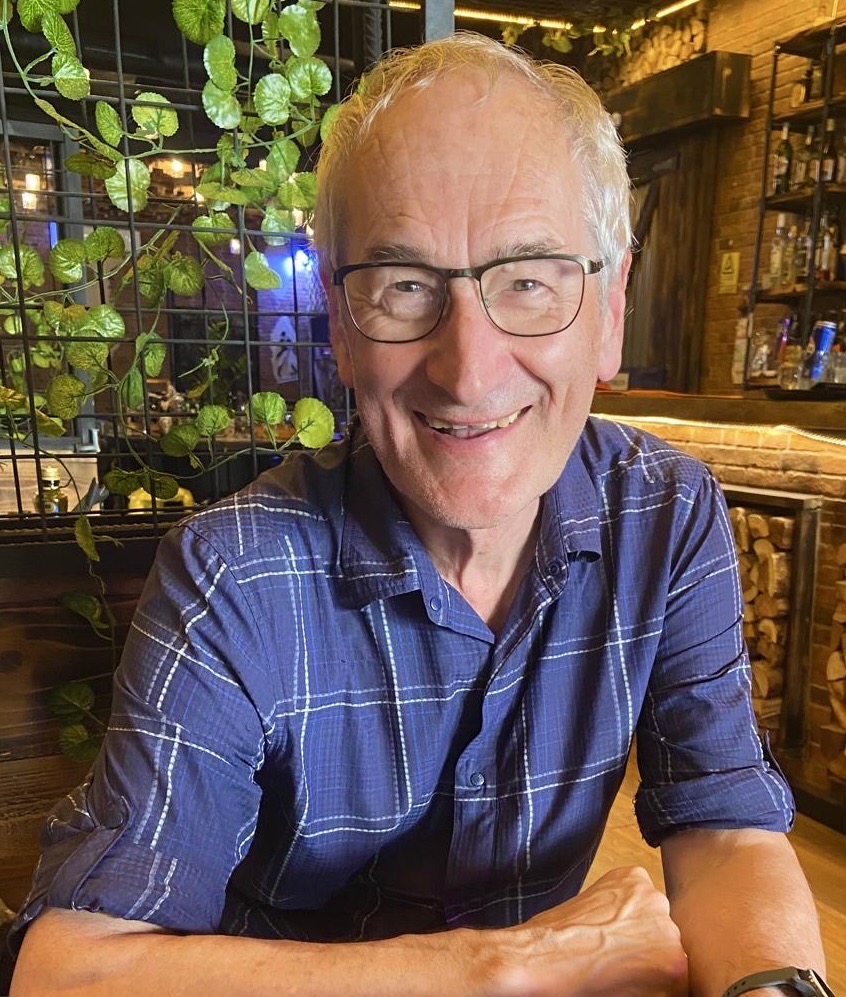


A LIFETIME OF CARING – Dr Derek King on childhood cancer, family and the changing face of medicine
Dr Derek King remembers the old children’s hospital in Aberdeen with affection.
The long corridors and particularly the open wards where nurses could stand at one end and see every child at once. The parents who sat together through long days and sleepless nights, forming friendships that lasted long after their children had gone home.
But above all, the dedication of staff that continues today.
Now, after nearly half a century in medicine and years helping guide children’s charity The Archie Foundation, Dr King is stepping back from his role as vice-chair of the board of trustees.
Looking back, he sees a career shaped not just by medicine, but by kindness, teamwork and quiet determination.
Born in Elgin, Dr King studied medicine at the University of Aberdeen, graduating in 1976. After completing his junior hospital posts in Aberdeen, he found himself drawn towards haematology almost by accident.
“One of my early jobs happened to involve patients with blood disorders,” he recalls. “Then a registrar post came up in haematology and that really set the course for everything that followed.”
After further training in Aberdeen and two years in Canada with his wife Heather and their young family, he returned to Scotland and eventually became a consultant in paediatric haematology and oncology at the Royal Aberdeen Children’s Hospital.
For decades, he cared for children with cancer and blood disorders across the north of Scotland, from Aberdeen to Orkney and Shetland. It was demanding work – often emotionally difficult but deeply rewarding.
“You were never just treating the child,” he says. “You were treating the whole family.”
Over the years, he witnessed huge changes in medicine. When he first started, childhood cancer care was carried out by very small teams. Specialist nurses were rare. Many treatments were still evolving and survival rates were lower than they are today.
One of the most important developments was collaboration.
Aberdeen became one of only three recognised Scottish centres within the United Kingdom Children’s Cancer Study Group (now CCLG – The Children and Young People’s Cancer Association), giving local families access to the same treatment protocols and clinical trials available in much larger cities.
“That meant children in the north-east could receive the same quality of care without families having to leave home for long periods,” he says. “Children with very rare types of cancer may need to go to a more specialised centre but care is always shared with some parts given in Aberdeen when possible.
“In the early days, children often required general anaesthetics simply to stay still for scans. Today, specially trained play therapists often prepare children so well that sedation is no longer needed.”
Dr King recalls one memorable moment during the early days of MRI scanning in Aberdeen.
“A little girl with a large tumour needed a scan and sedation wasn’t working. In the end we managed it by having her lie on top of her father inside the scanner. It made for an interesting image, but we got the scan done!”
He also saw huge advances in cancer treatment itself. New targeted drugs, genetic testing and proton beam therapy transformed outcomes for many children.
He helped establish late effects clinics in Aberdeen, supporting children whose treatment might affect growth, fertility or long-term health later in life. He also worked to ensure teenagers moving into adult services experienced a smoother transition.
“As children get older, they need independence,” he says. “You have to help them move towards adulthood with confidence.”
Much of Dr King’s later career was closely intertwined with The Archie Foundation, the charity which has transformed children’s healthcare across the north of Scotland, expanding its services across the country to include Tayside Children’s Hospital at Dundee’s Ninewells Hospital and the Highland Children’s Unit at Raigmore Hospital in Inverness, as well as Dr Gray’s in Elgin and children in Orkney and Shetland.
He was involved from the very beginning, speaking at the charity’s launch more than 25 years ago as fundraising began for a new children’s hospital on the Foresterhill site, next to Aberdeen Royal Infirmary.
The move to the new hospital in 2004 marked a major turning point.
“One of the biggest changes was the introduction of larger single rooms, something Archie helped fund by paying for extra space that the NHS could not fund so parents could stay overnight beside their children. The provision of parents’ accommodation with ensuite bedrooms gave a facility for parents travelling from a distance such as Orkney and Shetland to be near their child. That made a huge difference as it meant families could stay together during some very difficult times and is a cornerstone of the service the charity continues to provide today.
“Better infection control, improved scanning facilities, specialist treatment rooms and closer links with Aberdeen Royal Infirmary all helped improve care and the staff felt strongly we should remain as Royal Aberdeen Children’s Hospital, even though it is connected to the main hospital.
“The big advantage of being physically linked to ARI was easier access to CT scans and other scans that might be needed. without having to get an ambulance and get patients up there.”
Part of Dr King’s consultant role was as Service Clinical Director for Laboratory Haematology, based in the laboratories in Aberdeen Royal Infirmary. This provided a service for hospitals and general practices in Grampian and support for the laboratories in Elgin’s Dr Gray’s Hospital, Orkney and Shetland. An important part of the role was a telephone advice service for GPs.
After retiring from clinical practice in 2015, Dr King was persuaded by former colleague Professor George Youngson to join Archie’s board of trustees.
“He told me the charity needed somebody with ‘institutional memory’,” Dr King laughs. “Which I think was a polite way of saying somebody old enough to remember the old and new hospitals.”
As a trustee and later vice-chair, Dr King brought not only clinical expertise but decades of experience navigating the realities of the NHS.
He describes the role as both rewarding and challenging, especially during the Covid pandemic when fundraising events disappeared overnight and trustees faced difficult decisions about staffing, reserves and future planning.
“You suddenly realised just how serious the responsibility was,” he says. “You are responsible for public donations and making sure that money is used properly.”
He speaks passionately about the importance of charities like Archie enhancing care rather than replacing core NHS services. With the increasing funding challenges in the NHS, it has become more difficult to define what is core activity and should be provided by the NHS and where Archie can improve services.
“One of the central pillars of Archie’s work is making a difference and adding value that the NHS is not able to provide. People donate because they want to make life better for children and families. That trust matters enormously.”
Under Archie’s support, countless families have received emergency grants, accommodation close to hospital, bereavement support after the loss of a loved one or amid end-of-life care, specialist equipment and access to play, art and music therapy.
Sometimes, he says, it is the smallest gestures that matter most.
“If a family arrives in crisis and has forgotten clothes or pyjamas, a small grant from Archie can make all the difference. To us it may seem minor but to them it means the world at an incredibly difficult time in their lives.”
The year before his retirement, Dr King received the Doctor of the Year Award at the Scottish Health Awards.
Even now, retirement remains a relative term. Dr King continues to teach in the haematology laboratory and serves as a trustee with advocacy charity Advocacy Service Aberdeen.
Along with his colleagues George Youngson and Chris Driver, he is also involved in the writing and editing of a book to commemorate the 150th anniversary of the first dedicated children’s hospital in Aberdeen in 2027. Entitled ‘Healing the Bairns’, it is hoped it will be available by the end of this year, with profits from the sale of the book going to Archie.
Family remains central to his life. His daughter Shona works as a general practice pharmacist in London while his son Stuart (aka Dallas) is one of the trustees leading the campaign to reopen Aberdeen’s beloved Belmont Cinema. His wife, Heather, is a keen embroiderer and card maker, selling the latter in aid of Archie.
Looking back across nearly 50 years in medicine, Dr King remains modest about his own contribution, yet families across Scotland would say his work changed lives.
Perhaps the clearest measure of his career lies not in titles or buildings, but in the generations of children who grew up because dedicated doctors, nurses, the wider groups of staff and charities worked together to give them the best possible chance.
And through all the remarkable advances in medicine, Dr King believes one thing has never changed.
“The most important thing,” he says quietly, “is still caring for people properly.”